
Alongside our products, we run R&D programmes that push domestic space technology forward. Neuro-Orbit is supported by TÜBİTAK-TEYDEB.
AI in orbit · 2026–2028 · supported by TÜBİTAK-TEYDEB
Neuro-Orbit: AI-Enabled Satellite Flight Computer
Today’s satellites send almost all raw data to the ground and depend on operators to spot problems. Neuro-Orbit changes that. It is a flight computer that runs artificial-intelligence workloads in orbit, in real time, while keeping the determinism and reliability a spacecraft needs. The goal is to take the technology from TRL 3 to TRL 6.
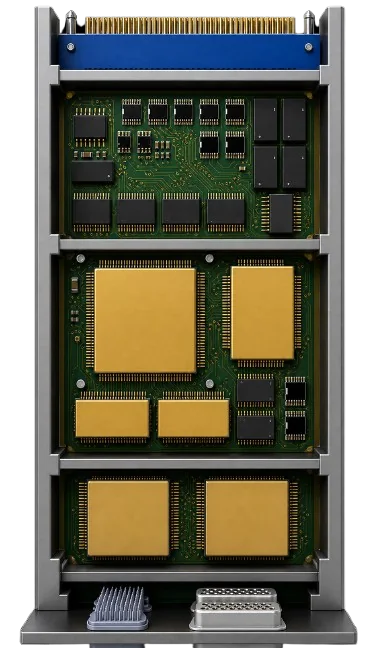
One board, many jobs
- AI Inference Engine: common on-board inference service
- Anomaly Detection: learns healthy telemetry and flags faults autonomously
- AI Star Tracker: attitude at ≥ 20 Hz from star images
- AI Navigation: GNSS orbit and time determination, ≥ 1 Hz PVT + PPS
- Image Processing: classification, cloud screening, compression, encryption
- Model Manager: uploads, validates and swaps AI models in orbit
- Radiation-Aware Scheduler: adapts inference to radiation events (FDIR)
- Federated Learning: shares model improvements across a constellation
Less downlink
Only useful results go to the ground, with a target of ≥ 95 % bandwidth saving on hyperspectral data.
Faster reaction
On-board fault detection in under 100 ms instead of hours.
Fewer boxes
One board can replace separate OBC, star tracker processor, GNSS receiver and payload computer, saving harness, mass and power.
Updatable intelligence
AI models are uploaded, validated and improved during the mission.
Neuro-Orbit is supported by the TÜBİTAK-TEYDEB 1501 Industrial R&D Projects Support Programme (Project No: 3261148).
Moon surface · engineering design complete
Lunar Rover Avionics: TTM-RVR-KIT
A rover on the Moon has no mechanic nearby. Every board has to survive radiation, lunar day-night temperature swings and long periods of unattended operation. Our lunar rover avionics kit is a set of SpaceVPX-compatible modules on a common backplane. You scale it by adding modules, not by redesigning.
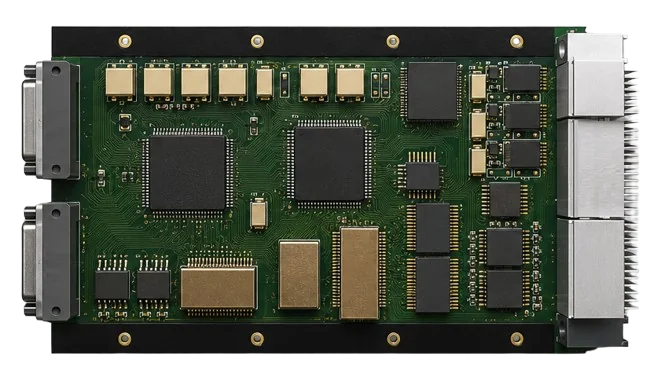
TTM-PM-SVPX · Processing
Quad-core COTS SoC, antifuse FPGA system controller, ECC-protected DDR and MRAM, SEL protection with LCL.

TTM-ADIM-SVPX · Analog-Digital I/O
12 × RS-422 RX, 12 × RS-422 TX, 2 × SpaceWire, 4 × CAN, 4 × RS-485, 16 opto-isolated GPIOs, 8 analog inputs.

TTM-MDM-SVPX · Motor Drive
8 × MOSFET motor-drive channels and 8 analog measurement channels.

TTM-PDM-SVPX · Power Distribution
Redundant 28 V inputs with EMI filter; monitored and protected 5/12 V rails; configurable 28/±15/±12/5 V outputs.
Each module: 160 × 100 × 20 mm. The same kit also fits landers, other surface missions and terrestrial robotic test beds.
Navigation · FPGA IP core in test
TetraGNSS: Space GNSS Receiver on FPGA and ASIC
GNSS receivers for space have to track satellites while moving at 7.5 km/s. They also have to survive radiation and fit a small power budget. Our team designed a flight-proven space GNSS receiver before, and TetraGNSS is the next generation. It is being developed in three steps:
1 · FPGA IP core
Multi-constellation (GPS / Galileo / GLONASS / BeiDou) baseband with high-dynamics tracking for LEO. It drops into our flight computers, so an OBC can also act as the GNSS receiver.
2 · GNSS receiver ASIC
The proven FPGA baseband moved to a space-compatible ASIC for lower power and mass.
3 · Receiver equipment
Complete unit with RF front-end, SoC/SoM processing and TetraGNSS software. It is verified on a GNSS simulator with static, automotive, aircraft and spacecraft scenarios.
IP cores · in verification
Space-Ready FPGA IP Cores
ECSS-compliant MIL-STD-1553B BC/RT and SpaceWire/RMAP IP cores. We will use them in our own flight computers and license them to other equipment developers.
Hardware platform
Modular Flight Boards
Every product is built from the same family of boards: processing, FPGA/SoC, SDR, GNSS ASIC, RF front-end, power, platform-interface, discrete-interface and ADCS-interface modules. See the modules →
Concept · AI payload
OrbitEye: AI-Based RF Spectrum Monitoring from Orbit
OrbitEye is an on-board AI payload concept for LEO satellites at around 600 km. During each pass it scans the RF spectrum up to 6 GHz, then detects, classifies and geolocates emitters and maps RF activity. Each pass is compared with earlier ones to reveal new signals, changes and anomalies, and only prioritised, high-value data is sent to the ground.
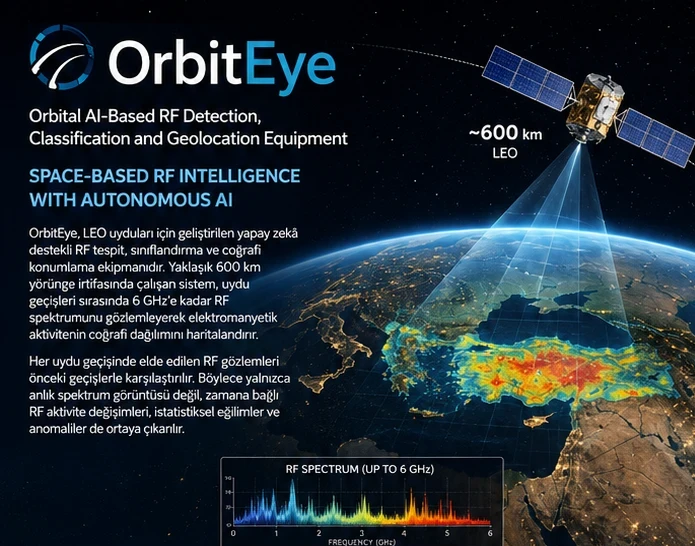
Detect & classify
Wideband spectrum monitoring with AI-based signal detection and classification on board.
Geolocate & map
Emitter geolocation from orbit and georeferenced maps of RF activity.
Compare over time
Multi-pass comparison shows new or vanished signals, trends and anomalies.
Smart downlink
The AI selects which IQ data to record and which results to send, making the most of limited downlink.
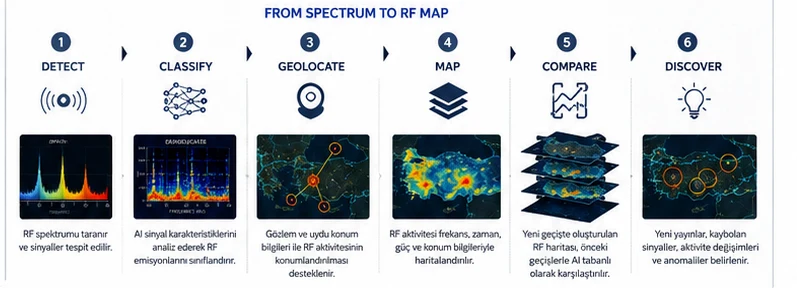
Concept pipeline: from a raw RF spectrum to a georeferenced activity map.
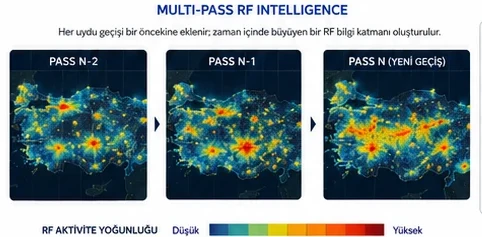
Concept renders: comparing RF activity across passes highlights what changed.
Interested in partnering on one of these projects?
We work with integrators, research institutes and new space companies. Let’s talk.